
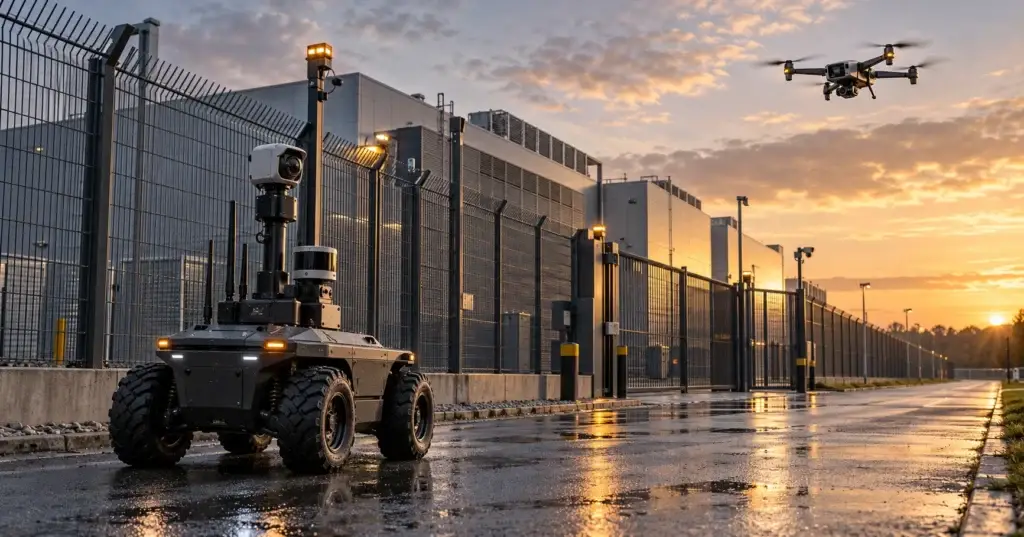
The drone sees from above, the ground robot inspects up close – and the human decides from a safe distance.
That is the operating model behind Project OVERVIEW, carried out with the support of the European Space Agency (ESA), which is testing robot- and drone-assisted automated response at a critical infrastructure site in the UK. According to the report, the project is co-funded by ESA’s Business Applications and Space Solutions (BASS) programme and the contract went to Excelerate Technology; the site itself is not named.
- Project OVERVIEW, co-funded by ESA, tests automated response to perimeter alarms at a critical UK infrastructure site: a drone-in-a-box and a ground robot work together.
- The drone gives a fast overview from above and can scout beyond visual line of sight; the robot gets close, gives a more detailed picture and keeps a technical presence where people cannot yet safely be sent.
- The aim is not to replace the human but to let responders arrive better informed; the drone launch, the authority of the robot to move, loss of communications and the decisions reserved for humans have to be regulated in advance.
Two tools, two roles
When a perimeter alarm goes off, the system can dispatch two complementary assets to the scene.
A drone launching automatically from a “drone-in-a-box” system can quickly survey the area, follow how the event develops and also scout beyond visual line of sight (BVLOS). In the trial this is Nokia Drone Networks’ solution: a weather-resistant docking station from which the drone takes off autonomously.
At the same time, the ground robot can approach the location of the alarm, provide a closer view of the situation and maintain a technical presence in an area where security staff cannot necessarily be sent safely yet.
So the drone gives a fast overview from above, while the robot can carry out more detailed reconnaissance on the ground. Together the two assets can deliver a much more complete picture than either of them alone. Picture a long stretch of fence: the drone covers the distance quickly and shows the overall situation, while the robot moves more slowly but can examine the fence line and the gate up close.
A link that survives communication failures
The images and other on-site data reach the local or remote security control centre over satellite and mobile communications. The report credits Excelerate’s hybrid satellite and cellular connectivity for keeping the data flowing even where terrestrial communications are compromised. This can be especially important if conventional ground communications are damaged or become unavailable during an incident.
That is a design question as much as a technical one: an alarm is only useful if the picture and the decision can travel the whole way. A similar logic applies to the path of video evidence, where the value of a recording depends on the weakest link in its journey.
The real value: a better-informed human
In my view, the greatest value here, too, is not replacing the human.
The aim is for responding staff to arrive at the scene with more accurate information:
- What triggered the alarm?
- Is there an intruder or an injured person?
- Can the area be approached safely?
- What resources are needed for the intervention?
The report makes the same point: security teams can assess high-risk situations from a safe distance before human responders are sent in.
What has to be regulated in advance
Autonomous response, however, places serious demands on the operator. The following have to be regulated:
- the automatic launch of the drone;
- the ground robot’s authority to move;
- the procedure to follow if communication is lost;
- which decisions remain in human hands under all circumstances.
These are not afterthoughts for the paperwork: they have to be decided when the system is designed and documented in writing, because at the moment of an alarm there is no time for debate.
Where is the security system heading?
The security system of the future may do more than send an alarm.
It launches the drone, sends the robot to the scene, assembles the situational picture – and then leaves the decision to the human.
Source: Advanced Television (Project OVERVIEW – an ESA co-funded robotic security project, October 5, 2026)
Questions, or an idea to talk through?
Whether it is a security system, the IT network behind it or just a thought on this article, I am happy to hear from you.

Gabor Horvath is a security systems engineer with more than twenty years of experience in the design, installation and operation of security systems. He has worked for government institutions, diplomatic missions and organizations in EU and NATO environments.